Marketing Diet Kool Aid to Adults

By Paul Yeager, author of Literally, the Best Language Book Ever

The difference between a success and a flop is often not the product; it’s often the marketing.

And marketing is certainly the first thing I thought of when I discovered that MiO Liquid Water Enhancer is basically diet Kool Aid for adults.

Ok, it might have been the second thing I thought of–after I wondered if they also offer a Solid Water Enhancer.

Seeing the commercials on television, I originally assumed that MiO must be catching on to the trend of either mineral- or vitamin-enhanced water, or at least one of those subtle naturally flavored drinks, but it’s not. As the ingredients listed below indicate, it’s just an artificially sweetened drink with an appropriate dye color.

MiO Liquid Water Enchancer Nutrition Facts

MiO Liquid Water Enchancer Nutrition Facts

In other words, it’s Diet Kool Aid for adults, or at least the combination of Diet Kool Aid and Crystal Light since MiO is mixed similar to a single-serving size of Crystal Light.

I’m not saying that there’s anything wrong with that–or with the product itself–but it is a good example of the language of marketing. I just think that they’re aiming for a different market than the Kool Aid market, so they needed to frame the product differently.

Personally, I’d rather have Diet Kool Aid–and it’s not like this guy couldn’t stand to lose a few pounds!
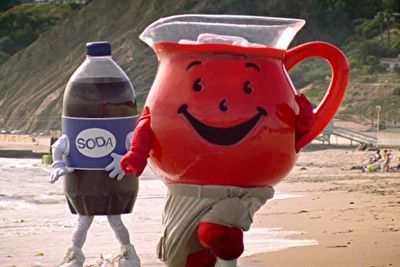
Kool Aid pitcher

Kool Aid pitcher

Posted in language | Tagged , , , , | 1 Comment

Another Impact

Although I’ve written about impact before, it bears repeating, especially since more and more people seem to be getting addicted to its use as a verb that means to affect.

Impact is a noun that denotes forcible contact or a collision between objects, as in The impact was strong enough to be felt miles away, or a verb that denotes something physically pressing closely into something else.

I’m not sure where its use as a verb meaning affect started, but it’s a recent development, most likely initiated either a) in order to create false melodrama or b) by someone who has poor grammar skills. Impact sounds much more dramatic than the correct word affected, which is what is usually meant when impact is used.

Dictionary.com, which has never met a grammar mistake it has not only liked but embraced, says, “Although recent, the new uses are entirely standard and most likely to occur in formal speech and writing.” Entirely standard? Why?

In other words, they’re preemptively spouting their descriptivist dogma in an attempt to prove they’re right—–but on what grounds? It sounds like on the grounds that this grammar error has been repeated many times by many people and is perpetuated in part by these kinds of dictionaries.

Sherry

Posted in grammar, language, writing | Tagged , , , , | Comments Off on Another Impact

Stresscalation?

As you know, we here at Everything Language and Grammar are all for making up words whenever it’s convenient because language changes, and since it does, we should all have the authority to change it ourselves.

All right, before you think we’ve gone all descriptivist on you, I’ll stop the sarcasm and give you today’s made-up word: stresscalation.

I guess it means escalation of stress, but some people are too busy and stressed to say all of that, so they’ve shortened it to one, easy-to-use non-word.

Posted in grammar, language, writing | Tagged , , , , | Comments Off on Stresscalation?

Prenatal Citizens?

By Paul Yeager, author of Literally, the Best Language Book Ever

I’ve said it before, and I’m sure that I’ll say it again…but…the language we choose to use is one of the best ways to show who we are and what we’re about.

We all, at least at times, select words very carefully in order to promote our agenda–some of us just do it in a more manipulative way than others.

That’s exactly what’s going on when someone uses the term prenatal citizen instead of fetus, as was recently done by Georgia Republican Bobby Franklin. Mr. Franklin believes that miscarriages should be investigated. In addition, he believes that a police report needs to filed and that a death warrant needs to be issued.

In order to make the case for such a radical idea, it’s certainly necessary to make it seem more reasonable, so he’s decided to label a fetus as a prenatal citizen.

Posted in language | Tagged , , | Comments Off on Prenatal Citizens?

Cancel the Ham, and Call Dominos Because Jesus Loves Pizza

According to the photo gallery in an AOL News story (Praise Cheesus! Face of Jesus Appears in Three-Cheese Pizza), Jesus loves pizza (perfect for Easter dinner). Jesus also loves:

  • Christmas candy (who doesn’t?)
  • Slightly overcooked chicken. (Why don’t Foreman grills come with a temperature control? I mean, you put the chicken in, but you can’t control the heat. The next thing you know, you have a picture of Jesus–but, more important, you’re still hungry.)
  • Dry toast (although…the pictures have a decidedly Statue of Liberty look to them, so Jesus does, indeed, love America more than other countries!)
  • Bacon grease (That can be cleaned with baking soda, which must means that bicarbonate of soda is the devil.)
  • Jar of Marmite (whatever that is)

I know. I know. This is completely off topic, but if Jesus sightings in food isn’t non-denominational off-topic entertainment for everyone, then what is?!?

Posted in humor, off topic | Tagged , , , | Comments Off on Cancel the Ham, and Call Dominos Because Jesus Loves Pizza

Like Might Keep You from Being Hired

By Paul Yeager, author of Literally, the Best Language Book Ever

We all have a verbal tick or two, but using the word “like” incorrectly during an interview might be reason enough for a potential employer to say, “Like, thanks but no thanks.”

Recent research conducted by the University of North Carolina’s (Chapel Hill) Department of Psychology indicated that the use of words (or sounds) like “um,” “like,” and “ya know?” might be enough for an interviewer to pass on a candidate.

Read more at Jobs.aol.com: So um like I really want this job, ya know.

We’ve been accused of being too fussy about language, but this isn’t about being perfect. It’s about using language the best you can so that you have the best chance of personal success.

Besides, it’s like annoying.

Posted in language | Tagged , , , , | Comments Off on Like Might Keep You from Being Hired

Better Language Skills Might Mean Less Risk of Dementia

By Paul Yeager, author of Literally, the Best Language Book Ever

Research from an interesting study, the Nun Study, states that more complex grammar when young might mean a lower risk of dementia as an older person. More information can be found on a Pittsburgh Post-Gazette blog; however, since it’s a premium site, access might be limited.

The nuns were originally being studied because they had never used tobacco or alcohol or had given birth, but during the research, it was discovered that they had written essays during their youth about why they wanted to become nuns in the first place.

These early essays were then studied.

According to the Post-Gazette story above:

Results obtained by testing the cognitive functioning of the surviving nuns (93) and brain examinations of the deceased religious (14) showed low idea density (a simplified definition: how many ideas presented in a sentence divide by sentence’s words) and low grammatical complexity in the early-life essays were associated with dementia in later life!

Interesting, and it seems to support other studies that indicate that more brain activity reduces the potential for dementia later.

Keep the thoughts and words flowing!

Posted in grammar, language, writing | Tagged , , , , , | Comments Off on Better Language Skills Might Mean Less Risk of Dementia

Plain Language

By Paul Yeager, author of Literally, the Best Language Book Ever

I know that this isn’t news since the Plain Language Act passed last year, but since I’ve recently talked about convoluted and over-inflated language, I thought I’d mention it now.

Law language is often full of doublespeak and confusing terminology, much of it with no apparent purpose other than to confuse those who aren’t used to reading such material, and the Plain Language Web site (related to the previously mentioned act) includes some “before” and “after” examples of laws.

The goal of the site is to highlight how much more understandable laws would be if written in plain language, but the before-and-after comparisons page also illustrates how confusing our daily communication may be if we use the same stilted, long-winded approach.

Here’s one example (before and the much simpler after):

Before

After notification of NMFS, this final rule requires all CA/OR DGN vessel operators to have attended one Skipper Education Workshop after all workshops have been convened by NMFS in September 1997. CA/OR DGN vessel operators are required to attend Skipper Edication Workshops at annual intervals thereafter, unless that requirement is waived by NMFS. NMFS will provide sufficient advance notice to vessel operators by mail prior to convening workshops.

After

After notification from NMFS, vessel operators must attend a skipper education workshop before commencing fishing each fishing season.

Posted in grammar, language, writing | Tagged , , , , | Leave a comment

Let’s Collaborate to Eradicate Collaborate!

By Paul Yeager, author of Literally, the Best Language Book Ever

I know it’s not going to happen, but I would love to get through one day without hearing the word “collaborate.”

No one works with anyone else any longer.  No one shares information. No one becomes someone else’s partner.

Everyone collaborates, collaborates, and collaborates some more.

This is especially true at my day job at the university (or, as they say, at the University since the school is so special that it deserves random capitalization), where collaboration between co-workers, departments, other universities (always small letters), and even between staff and students is at an all-time high.

We just collaborate, collaborate, and collaborate to the point that I can’t stand it an longer.

I think I’m going to do everything by myself!

Posted in grammar, language, writing | Tagged , , , , | Leave a comment

Buzzword Bingo

We talk quite a bit here about inflated, trendy language (also a popular topic in Literally, the Best Language Book Ever), but dailywritingtips.com has suggested 24 popular buzzwords that can be turned into a game of buzzword bingo.

The idea is to fill a bingo-like card with annoying catch phrases and mark them off as you hear them in meetings at work, and just like Bingo, the winner is the one who gets five such buzzwords in a row.

Here are a few of the words that would be on their card:

  • incentivize
  • granularity
  • metrics
  • touch base
  • leverage

All good choices!

Posted in grammar, language, writing | Tagged , , , , , | Comments Off on Buzzword Bingo