National Unfriend Day

By Paul Yeager, author of Literally, the Best Language Book Ever

According to Jimmy Kimmel, Facebook is cheapening the definition of the word friend and is, therefore, proposing a National Unfriend Day for November 17.

This idea fits in with some of the other odd holidays in November and December, and in my opinion, that’s what the former word of the year deserves.

Posted in grammar, humor, language | Tagged , , , , | Comments Off on National Unfriend Day

Interview: A New Definition, Thanks to Randy Moss

By Paul Yeager, author of Literally, the Best Language Book Ever

I love it when professional athletes talk. If it’s not a humorous mixture of mangled cliches and mixed metaphors, then it’s some outlandish, self-centered statement that only a media person trying to make a name for himself is interested in hearing.

Now, one  professional athlete, Randy Moss, has decided to redefine the word interview:

If it is going to be an interview, I am going to conduct it. So, I will answer my own questions and ask myself the questions and give you the answers. So from here on out, I am not answering any more questions the rest of this season.

Interview used to mean “a meeting or conversation in which a writer or reporter asks questions of one or more persons from whom material is sought for a newspaper story, television broadcast, etc.”

Now, thanks to Randy Moss, it’s a one-man show!

Maybe Randy will also redefine the word pompous to mean “regard with the utmost esteem.” If he does, then he’ll have plenty of company from the world of professional sports.

Posted in humor, language, sports | Tagged , , , , , , | Comments Off on Interview: A New Definition, Thanks to Randy Moss

I Wish I Was Wrong, But I’m Not: More on Subjunctive

By Paul Yeager, author of Literally, the Best Language Book Ever

Sherry previous wrote about the subjunctive mood (Subjunctive Uses Were Not Was) a while ago, but I recently wrote about it on my writing tips for my job at Penn State: I Wish I Was Wrong, But I’m Not, so I thought I’d link to it here since it’s such a common error.

Posted in grammar, language, writing | Tagged , , , , , , , | Comments Off on I Wish I Was Wrong, But I’m Not: More on Subjunctive

Even Bing Crosby Believed in Sports Jinxes

By Paul Yeager, author of Literally, the Best Language Book Ever and Weather Whys: Facts, Myths, and Oddities

One of the funny things that sports fans do is believe that they can influence the game by attending it, watching it, listening to it, or even being in the same country as the game.

If that were true, imagine the competing influences if the New York Giants were to ever play the New York Jets in the Super Bowl, with millions of fans on each side jinxing the outcome of the game. The greatest city in the world would likely crumble in the midst of the tumultuous energy of so many would-be jinxers.

Either that, or the winner of the game would actually be determined by the players on the field rather than the fans.

The silliness of the superstition of fans believing that their mere following of a game will result in a negative outcome extends beyond the average fan to the superstars of entertainment.

It turns out that Bing Crosby felt the same way, fearing that his merely being in the country would jinx the Pittsburgh Pirates in the World Series in 1960 against the New York Yankees. Crosby was a part-owner of the Pirates (who through the early 90s were one of the great franchises of all time–strange what 17 consecutive years of losing does to a team’s reputation).

As a result, Crosby hired a high-tech company to record the game, long before the modern VCR was invented, and the resulting tape of the historic 7th game (when Bill Mazeroski hit a game-winning walk-off homerun for Pittsburgh) is the only known copy of the game.

Because of Bing Crosby’s illogical and common sports paranoia, the game is not lost forever.

Read more at the New York Times.

Posted in sports | Tagged , , , , , | Comments Off on Even Bing Crosby Believed in Sports Jinxes

Don’t Let Your Kids Shop and Drive

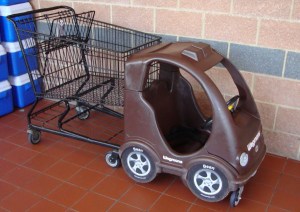
This is an off-topic post about the most annoying invention in the grocery store since the little sprinklers that turn on every time you reach for a carrot: the oversized shopping cart that allows a child to pretend to drive while mommy or daddy shop.

Oversized grocery shopping cart

Oversized grocery shopping cart

Let’s take a quick look at what parents believe people are thinking about them versus the actual thoughts of other customers:

  • Parents: Billy is so cute pretending to drive.
  • Customers: That freaking cart is larger than my car; move it—and that overly indulged child–out of the way so that I can shop.
  • Parents: Billy is going to be a good driver, just like me.
  • Customers: The way you make turns and maneuver through traffic with a shopping cart, it’s no wonder the parking lot is like a demolition derby competition.
  • Parents: It’s nice that Billy can be distracted while I shop.
  • Customers: Why do parents always feel the need to entertain or distract their children? Our parents taught us how to behave when we were young, not looked for more and better ways to distract us. What’s next–a DVD player in that thing?
  • Parents: It’s nice that Billy doesn’t pull food off the shelves while I shop.
  • Customers: I’d rather he knock a can of corn off the shelf that you have to pick up rather than block all of the cereal from Alpha Bits to Fruit Loops while in a cart half as long as a football field.
  • Parents: I never hear Billy whine when he’s one of these carts.
  • Customers: Can’t you hear you child whining? Oh, wait, probably not since he’s 10 feet in front of you and aimed the other direction. He’s whining at me, and I don’t care!
  • Parents: These carts make shopping a pleasurable experience; I only wish there were more of them.
  • Customers: Which aisle is the dynamite in?

–Paul

Posted in humor, off topic | Tagged , , , , | Comments Off on Don’t Let Your Kids Shop and Drive

If/Then Construction

When I put my meteorology hat aside and focus on editing, one of the most persistent errors I see is with the if/then construction when using a conditional sentence.

When one clause of sentence is only true if a condition is met (if it’s not one thing, then it’s another), the sentences need to be separated by “, then.”

I know that the “then” is typically not used in common usage, but there’s a good reason for continuing to do it the proper way: It might lead to confusion when the shortcut is taken.

I wrote a little more about it in a recent writing tip on the Administrative Information Services Web site.

If you want more information, then check it out.

–Paul

Posted in grammar, language, writing | Tagged , , , , | Comments Off on If/Then Construction

Awesome Hurricane Katrina Video

By Paul Yeager, author of Weather Whys: Facts, Myths, and Oddities and Cloudy and Cool.

Awesome is often used to mean something incredibly good, but technically, it means something that inspires awe of any type. When I saw that the video of Hurricane Katrina, released by NASA five years after the devastating storm, the only word that came to mind is awesome.

See the video in the NASA Releases Eye-Opening Satellite View of Hurricane Katrina story on AOL news.

Posted in language, weather | Tagged , , | Comments Off on Awesome Hurricane Katrina Video

The Point is Mute

By  Paul Yeager, author of Literally, the Best Language Book Ever

This is another example of what I like to call “Close but no cigarette.”

I don’t remember where I heard it, as a good blogger should, but I recently heard someone on the television say the incorrect “the point is mute” instead of the correct “the point is moot.”

The point is moot, of course, means that the point has no practical significance. For instance, the point about how to spend the holiday bonus is moot after being fired from the job.

The point is mute would mean that the point cannot speak, which is the case for all points.

I know. I know. Common usage has most likely blurred the two, and if a mistake made often enough is reason for you to accept something, then this post is mute.

Posted in grammar, language, writing | Tagged , , , , , , | Comments Off on The Point is Mute

Humorous Resume Mistakes

By Paul Yeager, author of Literally, the Best Language Book Ever

Who doesn’t enjoy a little humor related to funny typos, mistakes, and wacky statements on a resume or cover letter–except for those who made the mistake and didn’t get the job, that is?

We all make mistakes–believe me–but when I see some of these things I wonder if they’re not made up. 

I mean, seriously, who would put “Exposure to German for two years-but many words are inappropriate for business” as a language skill?

Follow the link below to see the AOL (I love AOL for some reason…) article:

Resume Mistakes That Keep Hiring Managers Amused But Cost You the Interview

Posted in grammar, humor, language | Tagged , , , , , | Comments Off on Humorous Resume Mistakes

New Word of the Day: Candwich

By Paul Yeager, author of Literally, the Best Language Book Ever

That’s right, ladies and gentlemen. We apparently have a new word, candwich. The new word is for a new product: a sandwich in a can.

You know me–I’m not in favor of just making up new words when our old standards will work fine, but hey, if we’ve decided hat it’s finally time to can a sandwich, then we may as well call it something. Candwich is a silly enough name for a silly product.

One of the reasons that this new product could be created (although I’m not sure how different it is from a sandwich wrapped in plastic) is the development of a bread that can stay fresh inside of a can for a year.

Year-old bread…I gotta get me some candwiches.

Posted in humor, language | Tagged , , , | 1 Comment