The Appointment is Not for the Doctor!

I know that this is a pet peeve more than a serious language error (A Pet Peeve Warning is in Effect!), but when you have an appointment with a doctor, it should be called a doctor appointment, not a doctor’s appointment.

Think about it.

An apostrophe used in an example like this is generally used as a possessive, such as Bill’s car (the car belongs to Bill). It is also sometimes used in the genitive case, which is when a noun modifies another noun, such as Jack’s height (Jack doesn’t own his height; it’s a trait of his).  

When you say that you have a doctor’s appointment, you’re unwittingly referring to an appointment that the doctor has; it’s parallel to saying  that the car belongs to Bill when saying Bill’s car.

Maybe he has an appointment with his financial advisor, but that’s not what you mean. Technically, the doctor has an appointment with you, but you’re concerned with your appointment with him. In other words, it’s Your (Paul’s) appointment with the doctor, not a doctor’s appointment with  you (Paul).

To further make my case, you never say that you have a dentist’s appointment. You probably say that you have a dental appointment or a dentist appointment instead.

Do the same with the doctor; it’s a medical appointment or doctor appointment.

–Paul

Posted in grammar, language, writing | Tagged , , , | 5 Comments

Talk Offline

As I mentioned in Literally, the Best Language Book Ever, it’s not surprising that many language trends begin at work since we spend so much time there. Talking offline is certainly one of those trendy phrases–one that started several years ago and now is standard workplace fare.

According to a business dictionary, to talk offline means to continue a line of discussion outside of the original context, typically a different meeting, time, or medium. Since being online or offline is typically understood to mean on the Internet or off the Internet, there is room for confusion, especially for those who haven’t heard the term before.

Besides, it’s annoying to hear time and time again when something more informative, such as “That’s a good point, but we’ll talk about that next week” or “That’s not directly related, so you and I can discuss that tomorrow” or “We need to discuss that but not with everyone in this meeting” would also work.

A larger question is why businesses have their own dictionaries. I though that business people spoke the same language as the rest of us; thus, they wouldn’t need a business dictionary–they would merely need a dictionary.

Perhaps this is proof that business-speak is not standard English.

–Paul

Posted in language, writing | Tagged , , , , , , | Comments Off on Talk Offline

Best Weekend of the Year!

I know that I’m probably in the minority, but this weekend–the one during which we return to standard time–is one of my favorite weekends of the year, unlike when we start daylight-saving time in the late winter (47-hour weekend).

I understand those of you who miss the extra hour in the evening, but it doesn’t have much value in the northern part of the country in November anyway. The leaves are off the trees, and the weather is turning colder; evening outside time isn’t a priority. Besides, after the change, it won’t be dark when I wake up in the morning, and it seems as if I’m sleeping an hour later for a couple of weeks.

And who wouldn’t enjoy a 25-hour Saturday.

–Paul

Posted in off topic | Tagged , , , | Comments Off on Best Weekend of the Year!

Try Less; Do More

Try is one of those simple, little words that we don’t give much thought to, but the difference in how we use the word is the difference between persevering and lacking commitment.

If at First You Don’t Succeed…

If you don’t have multiple examples of situations in which a failed attempt (or several) was  followed by a successful outcome, then you give up too easily. Perseverance and determinations are keys to success, and the common wisdom of “If at first you don’t succeed, try, try again” is its stated motto.

The number of successful writers, singers, actors, musicians, and businessmen would most likely be very low if they stopped at the first rejection rather than continuing. Nothing is more vital to a successful outcome than continuing to try–unless you’re using it as a way to indicate a lack of commitment.

The Negative Side of Trying

We’ve all said things such as “A Tupperware party on Super Bowl Sunday? Sounds great. I’ll try to make it” when we mean “A Tupperware party on Super Bowl Sunday? No way!” often enough to know that we use the word try as a way to show a lack of commitment.

That lack of commitment doesn’t end with being too passive to say how we really feel (like the previous example); it extends to important parts of our lives.

We often say things such as “I’m trying to find a better job” or “I’ll try to get my homework done on Friday afternoon so that I can enjoy the weekend” or “I’ll try to lose weight after the holidays.”

With all of those statements, the word try (or trying) gives the speaker a way out of meeting that commitment–an escape clause. (The one about losing weight has a double out since it’s pushed back until after the holidays.)

We’ll have much more luck getting that job, completing that homework, or losing that weight if we do so with a strong sense of commitment.

Stop trying and start committing.

–Paul Yeager

Posted in language, words to live by | Tagged , , , , , , | 2 Comments

Costly Language Mistakes

Communication can be costly because how well you communicate will largely dictate your success, but I didn’t know a communication mistake could cost a business $340,000,000 (340 million)!

That’s what happened when a Japanese trader accidentally sold 610,000 shares of a stock for 1 yen instead of trading 1 share for 610,000 yen. Yikes! Talk about bad days at work.

A recent switched.com post (5 Typos That Broke the Bank) makes reference to this error, along with a $40,000 missing “l” and a typo that sends a woman 1,500 miles away from her intended destination.

Boy, I hate when that happens.

–Paul

Posted in grammar, language, writing | Tagged , , , , | 2 Comments

Stop the Insanity!

I always think of 1990’s health guru Susan Powter when I see someone using two spaces after a hard stop (period, exclamation point, question mark, etc.) in 2009. Not only is the reasoning behind the double space antiquated, but it drives copy editors crazy! As Ms. Powter would say, “Stop the insanity!”

It’s 2009, not 1989!

The two-space-after-a-hard-stop guideline started as a way to make typing on a typewriter (remember those?) more legible since the amount of space taken by all keys on a typewriter is uniform. For instance, an “i” takes up as much space as ‘w.’ As a result, an extra space was added after a hard stop, believing that it would make the print easier to read since breaks would be more identifiable.

We could argue that point, but it’s moot anyway. One of the few places you can still find a typewriter is in the landfill.

Extra Spaces Deleted

Many online software content management systems will automatically delete any extra spaces inserted into a text file, including those after a hard stop. It’s a waste of time to put them in.

Nearly all Web style guides state that there should be a single space after a hard stop, so if they’re not automatically deleted, they’ll be manually deleted by an annoyed copy editor.

Publications (books, newspapers (destined to go the way of the typewriter, perhaps?), magazines, and brochures) are nearly universally printed with one space after a hard stop. They’ve moved on–can’t you?

Awkward Text

Word processing software packages often automatically justify text (which adds and subtracts space between letters throughout the entire line to make the right margin consistent), or at least include that option. An extra space in this format looks especially awkward.

Typewriter-to-Person Communication

The ony type of communication that the double-space is considered acceptable is any type of typewritten material that is not also printed in an electronic format, so unless your office hasn’t “upgraded” from the file cabinet to a computer, it’s time to “upgrade” your punctuation.

–Paul

Posted in grammar, language, writing | Tagged , , , , , | 5 Comments

Compound and Complex Sentences

Good writing comprises different elements, for example, clarity, honesty, and correct basic mechanics. One of those mechanics is the ability to vary sentence structure. More mature writing consists of more than just what are called simple sentences. A simple sentence is an independent clause that has a subject and a verb and expresses a complete thought.

Example: I am a freelance writer.

Example: He studies in the library after school.

Example: We like to take walks.

While simple sentences have their places, too many of them make your writing boring, boring, boring. Variety really is the spice of life—-even when it comes to writing mechanics. That’s why good writers use both compound sentences and complex sentences in their writing.

A complex sentence is a sentence with an independent clause and at least one dependent clause.

Example: While I might hitherto have been silent, it’s time for me to tell you how I feel.

Example: After our morning meeting, we’ll be working on the presentation for tomorrow.

A compound sentence is a sentence that contains at least two independent clauses.

Example: I might be willing to forgive, but I’m not able able to forget.

Example: She works on the fifth floor; he works on the third floor.

Sherry

Posted in language | Tagged , , , , | Comments Off on Compound and Complex Sentences

Voluntary Social Distancing and Self Isolation

If you have the flu, one of the best things you can do to prevent its spread is what many experts now recommend–participate in voluntary social distancing or self isolation. Sure, those options will help, or you could do what we’ve been told to do for years–stay at home when you’re sick.

They’re the same thing, of course, but today’s modern flu sufferer deserves a term more representative of the convoluted, over-inflated  language of 2009.

Stay at home when you’re sick is too straightforward, direct, and boring. Voluntary social distancing sounds like more fun, which is something that you’ll need given the quality of daytime television. You’re doing something modern and sophisticated.

Besides, tell me that having a self isolation day doesn’t have more appeal than a sick day.

And when you’re stuck at home, with a box of sanitary paper product needed for your productive cough and nasal discharge, you certainly need all the fun that inflated language can give you.

–Paul

Posted in language, writing | Tagged , , , , , , , | Comments Off on Voluntary Social Distancing and Self Isolation

Autumn in Central Pennsylvania

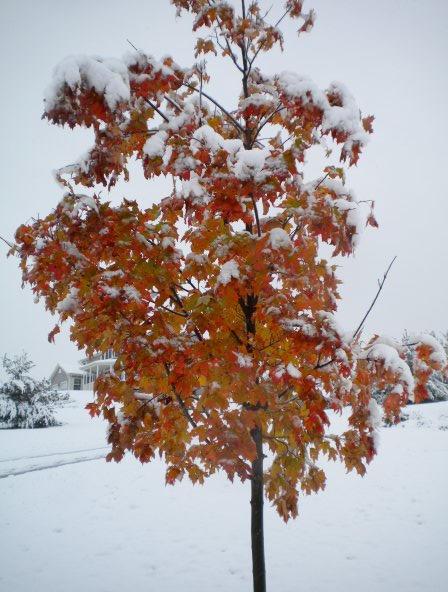
We thought we’d go off topic today and show you pictures of a historic weather event where we live. (Don’t forget about Paul’s weather blog, cloudyandcool.com, which focuses on weather from a national perspective, including several posts about weather forecasts for the 2009-2010 winter.)

Not only did we establish a record for the earliest official snowfall, but we did it with flair–several inches fell, not just a few innocent flakes. The following pictures were taken by our friend Paula, who lives in a neighboring town. 

Snowflower or Sunflower?

Sunflowers weighed down by a heavy October snow

Sunflowers weighed down by a heavy October snow

Collision of Seasons

Fall tree covered by October snow

Fall tree covered by October snow

Fall and winter collide during October snow

Fall and winter collide during October snow

Disaster Emergency
The scene was beautiful in an odd way, with bright autumn colors mixed with scenes reminiscent of winter holiday cards, but the beauty was overshadowed by the danger. The heavy, wet snow falling on trees in full foliage resulted in a severe amount of damage to trees and power lines (at one point, nearly 20% of the customers of the main power supplier were without electricity), and many homes were severely damaged by fallen trees and limbs.

With the potential for another round of heavy snow from Friday night through Saturday night, this could be the type of weather event that leaves its mark for years and years to come, at least  in terms of damage to property and trees.

More pictures are available from friend Jesse on The WeatherMatrix Blog.

–Paul and Sherry

Posted in off topic, weather | Tagged , , , , | 2 Comments

Annoying Work Words

It’s been my experience that executives have been more responsible for annoying, trendy language at work than the rest of us, but a recent survey of executives has revealed their top language pet peeves.

One of the most annoying is the completely useless phrase “it is what it is” as if it, whatever it is, could be what it isn’t.

Other words that made the list include disconnect, which is one that’s annoyed me for quite some time (future post?) and reach out, cutting edge, interface, and leverage, all of which I mentioned in Literally, the Best Language Book Ever.

Oh, I guess I should give you the link to the article, huh? Click on The Most Annoying, Overused Words in the Workplace for the survey results.

–Paul

Posted in grammar, language, writing | Tagged , , , , , | Comments Off on Annoying Work Words