Today’s New “Word” Is Logomisia

By Paul Yeager, author of Literally, the Best Language Book Ever and Weather Whys: Facts, Myths, and Oddities
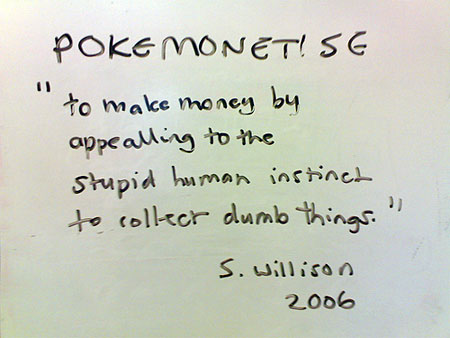
a neologism: pokemonetisation

What if someone who doesn’t like the way in which we make up new words for no reason or change the meaning of existing words as part of superficial trends finds a made-up word that accurately represents his dislike of that process?

Well, if that person is me, he writes a post about it!!

The new “word” is logomisia, and it means, according to the Urban Dictionary, “disgust for certain words or a particular word; a disgust for certain words or for a particular word.”

The word does not seem to appear in regular dictionaries or even in dictionary.com, which seems to embrace any new word or new usage of a word quickly.

Don’t feel bad. We all experience logomisia at some point–even the typical descriptivist who believes that common usage is all that’s needed to change language.

Embrace it, and go ahead–use the new “word.” You know you want to.

For the record, the new (and often useless) word is called a neologism, and the above image is a neologism from plasticbag.org.

Posted in grammar, language, writing | Tagged , , , , , | Leave a comment

How to Deal with Nasty People

By Paul Yeager, author of Literally, the Best Language Book Ever and Weather Whys: Facts, Myths, and Oddities

mean person pointing

We have to deal with all kinds of people during our daily lives, so we need to know how to deal with them. Most are easy to communicate with, but it takes special care to communicate with those who are unpleasant or downright nasty.

A syndicated column from Chicago Tribune columnist Alexia Elejald-Ruiz (How to deal with nasty people) might give a few tips.

The two that I think might be most effective are not getting into an argument with the nasty person (I have a rule that I only talk to rational people!) and making the person repeat an unkind statement.

It takes quite a person to insult someone twice in a row.

(Image from demotivationalposters.org)

Posted in language | Tagged , , | Comments Off on How to Deal with Nasty People

The 20 Best Books for Language Lovers

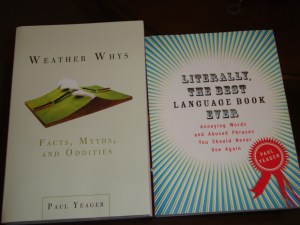
Paul Yeager's books

Paul Yeager's books

I recently came across a blog that highlights the 20 best books for language lovers, and I was honored to see that my book (Literally, the Best Language Book Ever) made the list!

If you love language, there are many worthwhile books to consider reading, especially number 18!

Posted in language | Tagged , , , , , , | Leave a comment

Communication Becoming More Shallow

By Paul Yeager, author of Literally, the Best Language Book Ever and Weather Whys: Facts, Myths, and Oddities

people texting

You know, sometimes I feel especially curmudgeonly (hey kids, get out of the yard!) when I complain about the way people communicate these days, with a short attention span, sloppy grammar, and punctuation influenced by typing on a mobile device the size of postage stamp. It’s all very impersonal and ineffective.

That’s why it makes me feel better when I see a college student who feels that real communication is becoming more shallow, especially when she does such a nice job of saying so.

Her name is Vera Greene, and she writes for Penn State’s Daily Collegian.

Image from Visual Photos

Posted in grammar, language | Tagged , , , , , | Leave a comment

Opening Night of Football and Football Cliches!

By Paul Yeager, author of Literally, the Best Language Book Ever

Charlie Brown and Lucy van Pelt

The NFL season opens tomorrow with a special Thursday edition of Sunday night football on NBC. Or, is it a special Thursday edition of Monday night football on ESPN? Or, is it a special preview of the upcoming Thursday night football telecasts, which kicks off (nothing begins in football–it always kicks off) on week 10 on the NFL Network (meaning that most people won’t be able to watch)?

I’m not sure, but since we here at Everything Language and Grammar enjoy football, we’re glad it’s here.

Unfortunately, it’s not always a joy to listen to the announcers because of their tendency to use cliches or make grammatical mistakes. I mean, seriously, if you want a good drinking game, then take a drink every time Troy Aikman says “what” (or “watt” as he says it) when it doesn’t belong in a sentence, such as “That’s a longer pass than what he normally throws” instead of simply “That’s a longer pass than he normally throws.”

You’ll be more tipsy than Joe Namath during a Suzi Kolber interview by the middle of the second quarter.

Speaking of football cliches, here are a few of the worst 20, according to the Bleacher Report:

  • The other team just wanted it more.
  • He’s deceptively quick.
  • We have to play a full 60 minutes.
  • They have to take care of the football.
  • That guy’s a throwback.
Posted in humor, language, sports | Tagged , , , | Leave a comment

Call the Police!!!!

By Paul Yeager, author of Literally, the Best Language Book Ever

I’m of the opinion that one problem with using too many exclamation points is that it doesn’t work–the intended excitement is turned into melodrama. I wasn’t aware of this other potential problem: thievery.

According to the Centre Daily Times, thieves stole letters from a volunteer fire department sign, including four exclamation points. (Spring Mills is an exciting place, apparently.)

No exclamation mark

No exclamation mark

It’s no laughing matter, of course. How will they be expected to properly show the excitement that is Friday night bingo if they have no exclamation marks left?

Tell me. How?!!!!

Posted in grammar, humor, language | Tagged , , , , | 1 Comment

Sartalics: Lean Left for Sarcasm

By Paul Yeager, author of Literally, the Best Language Book Ever

Sarcasm is misinterpreted often enough when spoken, so imagine how often it’s misinterpreted through writing. That’s why the clever people at sartalics.com have started a petition to bring a sarcasm font to the Internet.

Sartalics logo (courtesy Sartalics.com)

The font is a reverse lean–like a left-leaning italics.

It’s an interesting idea, especially for those obsessed with social media sites such as Twitter, but I think it’s going to be a long time before it reaches the masses.

Posted in language | Tagged , , , | Leave a comment

Why Do They Hate Us?

By Paul Yeager, author of Literally, the Best Language Book Ever

Why do they hate us (U.S. citizens)?

The most common answer has always been that they hate our freedom, but I have breaking news from across the pond: It might be because of our language.

The BBC recently posted an article on the 50 most noted (a polite British way of saying annoying) Americanisms.

Dare I say that I must be British at heart since they make many excellent points, including:

  • Reach out instead of “ask.”
  • It is what it is, which is what it is: a phrase that says NOTHING.
  • Where’s it at? instead of the grammatically correct “Where is it?”
  • Ridiculousity, which the contributor hopes is being done tongue-in-cheek, but I wouldn’t bet on that–based on how often I hear the next one.
  • Physicality, which isn’t a word despite its growing use. (Note: People in the U.S. love to make up -ality words since it makes them sound so smart, at least to those who think anything ever uttered instantly becomes an acceptable word.)
  • Least worst option; the contributor suggests asking what the “most best option” might be.
  • Going forward instead of the standard “in the future.”

I could go on, but I don’t want anyone to get his knickers in a bunch.

Posted in grammar, language, writing | Tagged , , , , , | Comments Off on Why Do They Hate Us?

For All Intents and Purposes

By Paul Yeager, author of Literally, the Best Language Book Ever

This mistaken phrase for all intensive purposes falls into the category I like to call “Close but no cigarette.”

The correct phrase is for all intents and purposes, and it means, more or less, “for practical purposes.” A correct example would be: For all intents and purposes, the game was over in the fourth inning when the Yankees scored 10 runs.

The commonly used incorrect version of the phrase (for all intensive purposes) seems to indicate a sense of urgency, such as an intense situation. This is contrary to the original use of the phrase.

A Google search for the mistaken phrase results in 17 million-plus results. Granted, many of those are entries that point out that it’s incorrect; however, it is a general indication of the widespread use of the incorrect phrase.

For more information, see this Wise Geek entry: What does “All Intensive Purposes Mean?”

Posted in grammar, language, writing | Tagged , , , , , | Leave a comment

Web ACCESSibility, not ASSESSibility

By Paul Yeager, author of Literally, the Best Language Book Ever

Web accessibility is the process of making Web sites usable for everyone, regardless of a person’s disability. That’s an important topic since it’s only fair that all users be able use a site (and because the failure of Web owners to have accessible sites could result in litigation); however, it’s not the topic of the blog today.

The topic is the  pronunciation (or rather mispronunciation) of the word accessibility.

Accessibility should be pronounced as it’s spelled–access followed by an ibility. It should not be pronounced assess followed by an ibility as it often is.

That might seem obvious, but based on what I hear at my day job, roughly one-third of those working in the Web field say the word incorrectly, including those at a recent Web conference.

For many linguists, the simple repetition (and then spreading) of the mistake might mean that word should have two correct pronunciations. That’s a simplified version of their argument for the evolution of language. For instance, dove has been mistakenly used as the past tense of dive often enough that both dived and dove are fine.

I’m not a linguist, and I believe that a mistake is a mistake, whether made once or made a million times. And related to today’s topic, saying assessibility makes no sense to me.

Accessibility is about making sure that those with a disability can access a Web site; therefore, it’s logical that the word be pronounced as intended, with access as the first two syllables. Pronouncing it as if the first two syllables were assess can lead to confusion on  part of the listener, especially since someone often has to assess a Web site in order to see if it’s accessible.

Posted in language | Tagged , , , | Comments Off on Web ACCESSibility, not ASSESSibility